
Showing posts with label rangefinder. Show all posts
Showing posts with label rangefinder. Show all posts
Sunday, March 11, 2012
Making of a leather half-case
Labels:
accessories,
Leica,
rangefinder,
retro,
straps
0
comments
A fair amount of handwork goes into making a leather half-case for your camera. Makes you appreciate good craftsmanship!


Friday, February 24, 2012
Fuji X100 - now available in black
Labels:
announcement,
Fujifilm,
rangefinder
0
comments

Fuji is offering a limited (10,000 pcs actually) number of their X100 cameras in black, presumably making it more stealthy and professional looking. The only catch is the price of USD1700, which is significantly more than the usual silver X100. It does come with a leather cover, lens hood and protective filter though, but I'm not sure if the overall package is worth so much more than the USD1200 standard silver model. Still that's an option for those of us who have the extra dough in the pocket... I'm hanging out for the pink Hello Kitty version rumoured to be in the works.
Sunday, February 5, 2012
Labels:
announcement,
Leica,
lens,
rangefinder
0
comments
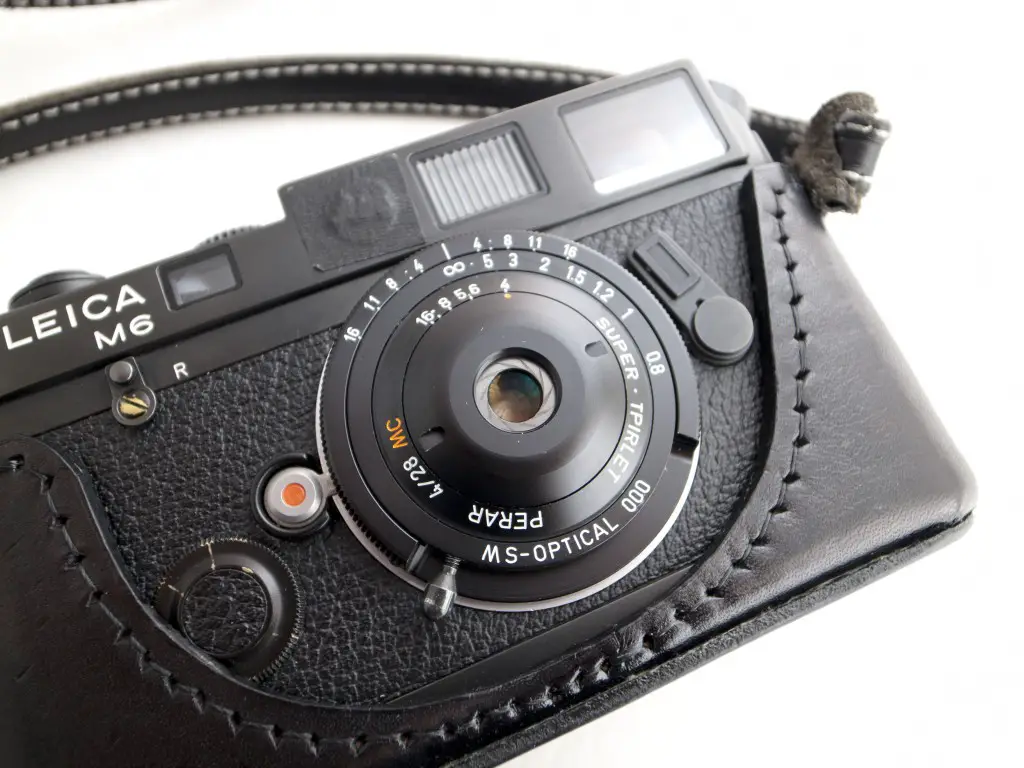

If you think that your rangefinder lenses are small, you ain't seen nothing yet! In Japan, a dedicated lens maker Mr. Miyazaki set-up his own company called MS-Optical to create astoundingly small lenses for rangefinders. He gained fame a few years back with his first product - the Perar 35mm lens, which really looks more like a body mount cap than a lens!
Now he has pushed the boundaries further with a new lens - the Perar 28mm f/4 lens, which is even smaller than his debut product! What's really amazing is that all his lenses are handmade by him in limited numbers, which explains their rarity and scarcity. They are popular for delivering good performance in an ultra-compact package.
You can order the lens from here.
Wednesday, June 15, 2011
Street photography: crop or crap?
Labels:
article,
photojournalism,
rangefinder
1 comments

Lust. Gluttony. Greed. Sloth. Wrath. Envy. Pride.
The last time I checked, cropping is not included in the list of the seven deadly sins. So why do photographers have this compulsive aversion to cropping their photos? Some say that shooting loosely and cropping in post-processing are signs of sloppy technique and a lack of discipline. And that cropping wastes precious real estate of film or digital pixels, degrading the quality of the final image.
I agree fully with the rationale to compose carefully prior to the exposure for certain types of photography, where the photographer has the luxury of time to compose before taking the shot. Landscape or portrait photography, or even commercial or still life photography all fall under such a category. There is little excuse for radically cropping the final image to achieve a new composition, other than to fit the print media size that may be different from the sensor aspect ratio. Or perhaps you really had a square or panoramic image in mind when shooting.
However, it seems to be mostly street photographers or journalists who oppose strongly to cropping their images. I suppose the fact that Henri Cartier Bresson – the most prominent figure in street photography – was a strong advocate of “no cropping” really helped to reinforce such a viewpoint. Photojournalists have resisted cropping for another reason – their editors and layout artists. Photojournalists compose the scene for a reason, and their composition might have included certain elements to tell the story. Editors and layout artists may crop the photo to suit the layout of the page, which frustrates the photographers greatly, and hence haphazard cropping of photojournalistic images may lead to misinterpretation of the original intent of the image, which is why cropping is taboo to some photojournalists.
Many street photographers however, embrace the practice of no cropping without a good argument. In street photography, the world is your stage, and it is an unrehearsed play. Things happen at random and you had hardly lifted the camera up and hit the shutter release, the moment has disappeared. The decisive moment, as Henri Cartier Bresson had aptly termed, is decidedly decisive.
Therein lies the problem of a no cropping policy. In the brief instant where you tried to capture the moment, the expression or action is more important than the composition. Miss the expression or action, and no amount of composition genius can make the photo a masterpiece. Composition can be tweaked in post-processing to improve the photo, so you capture the moment with the ideal composition.
It is a well-known fact that Henri Cartier Bresson, like many photographers, wait for something (or someone) to happen to the scene. In such instances where there is luxury of time to compose, he had the time to compose for the geometry of the composition, which he greatly loved. And I might add (in the risk of sounding sacrilegious), the great photographer himself was not immune to the lure of cropping, as his famous “Man jumping over puddle” image (a true example where the moment matters more than composition) has been proven to be cropped from a wider image (removing lamp posts and other distractions from the left side of the image.
While I am not arguing or lazy or careless framing and composition during exposure, the anally retentive attitude of some street photographers in their insistence not to crop the image seems illogical to me. A great moment happens in front of me, and I’m armed with a 35mm lens instead of a 50mm lens, but nonetheless I captured the image and it is great – except that the composition is too loose. Should I not crop my image? Obviously the wider image was not what I had in mind, but I did not have the luxury of time to change lens or move in closer. Is there something fundamentally wrong with cropping?
Some people say that cropping a photograph changes its meaning. That is true if someone else is cropping your image, but as photographers you infuse the image with meaning. So if you decide to crop your image to express the meaning better, then there should be no reservations about it. As photographers, you have already framed and cropped the world the moment you chose the lens and your viewpoint and composition. Cropping can reinforce your point of view in post-production; it does not change the fact that you had already wanted to impose your viewpoint from the point of exposure.
At the end of the day, I posit that cropping is not inherently detrimental for street photography. If you are cropping to improve the composition because circumstances made it impossible to compose well during exposure, I believe it would make for a better photo. Conversely if the cropping was due to laziness in composing your image when shooting, then it is just a lousy reason and unnecessary step to improve your images. Even so, the immorality can only be attributed to “sloth”, which means cropping is still not any of the seven deadly sins.
Copyright 2011 by Nelson Tan.
All Rights Reserved.
Visit www.nelsontan.com for more articles on photography!
Saturday, January 22, 2011
How quiet are Leica cameras?
Labels:
Leica,
rangefinder
0
comments

Photo credit: K. Praslowicz
Leica cameras have always been proclaimed as some of the quietest cameras around, making them suitable for street photography where stealth is preferred. Leaf shutter 35mm cameras can be quieter, but among focal plane shutter cameras I do love the Leica's cloth shutter with their "snick" sound instead of the metallic "clank" of other cameras.
If you hold a Leica in your hands for the first time without any other cameras for reference, you might wonder what's the fuss about, for the shutter is plainly audible as you click away. Test it against a couple of cameras, and you will realize why people don't hear you with a Leica.
Photographer K. Praslowicz recorded the clicks of several cameras at one location with similar shutter speed, to give you an idea of the relative loudness of each camera. Check out his article here!
http://www.kpraslowicz.com/2007/12/16/the-quiet-camera/
Monday, August 30, 2010
The quiet zen of photography
Labels:
film,
rangefinder,
Youtube,
zen
0
comments
For some people like David Spielman, photography is a therapeutic process, offering your mind a sea of calm amongst the rush of our daily lives. And to that intent, David prefers to shoot rangefinders and still uses film, because he likes the process of picture creation that way. For most of us using electronic DSLRs, computers and mobile phones everyday, you might find beauty and peace within the mechanical cameras and the tactile feel of film.
Slow down, see and observe, and then click off a frame.
Enjoy this short video clip!
Slow down, see and observe, and then click off a frame.
Enjoy this short video clip!
Sunday, November 29, 2009
The charm of Leica rangefinder cameras
Labels:
film,
German,
Leica,
mechanical,
rangefinder
0
comments
I love digital photography for the convenience and "cleaniness" of the photos. The images are always clean and sharp, which makes it easy for digital manipulation. And because I do not have to pay for the film, processing and printing, I do not feel the pinch of every time I shoot (after I forget the price of the DSLR).
But like the LP lovers who find a place for vinyl in the world of CDs, I find myself turning back to film ever once in a while. Film is therapeutic for some of us, when we load in a cartridge and pull the glossy brown film leader across the film gate. I still get anxious over the results, and I still get a thrill when I open the envelope of photos at the lab counter. Film is glorious in its own way.

Given that film photography is a return to the nostelgic world for me, my choice of camera must match the mood and manner as well. Which is why I love the Leica film-based rangefinder cameras. These are extremely sturdy and well-built cameras of Teutonic designs, which you will feel immediately in your hands. The heft of well-sculpted metal that sits right in your palm, with buttery smooth operations and clear bright rangefinder that opens up a window to the world. The feeling of winding to the next frame on a Leica M camera is heavenly.
Part of the charm of a Leica M film camera lies in the fact that every camera is handmade by craftsmen, who manually assemble and fine-tune each camera, just like a fine mechanical watch like a Lange or Patek. Vorsprung durch technique is definitely not the philosophy of this German company, since the technology in today's Leica film cameras is probably only equal to Japanese cameras of the 70s or 80s. But the built quality of Leica film cameras is unmatched, and here's a behind-the-scene look at how each Leica camera is built:
I leave you with a funny quote I read about digital photography:
"Digital is like shaved legs on a man - very smooth and clean but there is something acutely disconcerting about it."
-
But like the LP lovers who find a place for vinyl in the world of CDs, I find myself turning back to film ever once in a while. Film is therapeutic for some of us, when we load in a cartridge and pull the glossy brown film leader across the film gate. I still get anxious over the results, and I still get a thrill when I open the envelope of photos at the lab counter. Film is glorious in its own way.

Given that film photography is a return to the nostelgic world for me, my choice of camera must match the mood and manner as well. Which is why I love the Leica film-based rangefinder cameras. These are extremely sturdy and well-built cameras of Teutonic designs, which you will feel immediately in your hands. The heft of well-sculpted metal that sits right in your palm, with buttery smooth operations and clear bright rangefinder that opens up a window to the world. The feeling of winding to the next frame on a Leica M camera is heavenly.
Part of the charm of a Leica M film camera lies in the fact that every camera is handmade by craftsmen, who manually assemble and fine-tune each camera, just like a fine mechanical watch like a Lange or Patek. Vorsprung durch technique is definitely not the philosophy of this German company, since the technology in today's Leica film cameras is probably only equal to Japanese cameras of the 70s or 80s. But the built quality of Leica film cameras is unmatched, and here's a behind-the-scene look at how each Leica camera is built:
I leave you with a funny quote I read about digital photography:
"Digital is like shaved legs on a man - very smooth and clean but there is something acutely disconcerting about it."
-
Saturday, November 28, 2009
Retro chic with old rangefinder cameras
Labels:
article,
Canon,
rangefinder,
retro
0
comments
People are funny… we try so hard to out-do ourselves and make things better. And with technological progress and the digital edge, everything seems so nice and perfect. And we start to bemoan “the loss of spirit” with digital audio CDs and digital cameras. Suddenly everything analogue becomes in vogue and cool again… vinyl records and film are “in” once more!
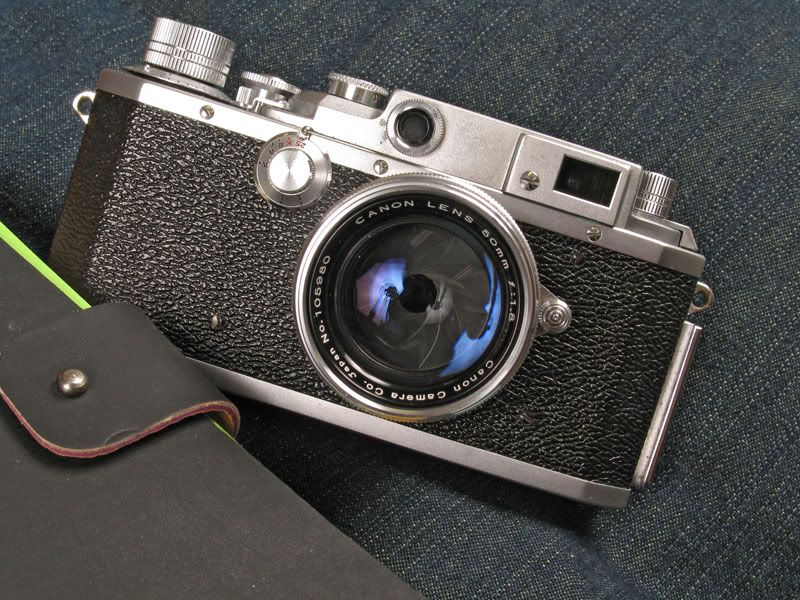
Of course, if you wanna be with the in-crowd, make sure you’re fashionable all the way. Having some old film camera from your dad’s drawer isn’t gonna cut it (seriously it only makes you look old-fashioned!). For true retro coolness, you gotta reach into your grandpa’s drawer for his ancient Leica rangefinder. But most probably you’d find something like this…

Of course, if you wanna be with the in-crowd, make sure you’re fashionable all the way. Having some old film camera from your dad’s drawer isn’t gonna cut it (seriously it only makes you look old-fashioned!). For true retro coolness, you gotta reach into your grandpa’s drawer for his ancient Leica rangefinder. But most probably you’d find something like this…
Subscribe to:
Posts (Atom)