
This video takes it a step further by examining how photographs can exaggerate the situation through selective portrayal of the situation, and how the presence of journalists alone can change the scene and behaviour of the subjects.
Showing posts with label photojournalism. Show all posts
Showing posts with label photojournalism. Show all posts
Friday, March 2, 2012
Is photojournalism really neutral?
Labels:
photojournalism,
Youtube
0
comments
This video takes it a step further by examining how photographs can exaggerate the situation through selective portrayal of the situation, and how the presence of journalists alone can change the scene and behaviour of the subjects.


Monday, February 27, 2012
WWII photos of Nazi Germany - in colour!
Labels:
German,
Leica,
photojournalism
0
comments

Photography by Hugo Jaeger
Most of the photo documenting the Second World War were shot in grainy black & white film, which is why it may come as a surprise that Hitler and his Third Reich Germany were photographed in color, no doubt for propaganda purposes. Thanks to Hugo Jaeger's photography, we can witness the Nazi era in full Kodachrome colour - which really looks eerily surreal given the modernity of colour. In fact, they look like they came off the set of a movie! Be sure to check out Hugo Jaeger's colour photos of Nazi Germany at this link.
Thursday, February 23, 2012
An interview with Mary Ellen Mark
Labels:
Interview,
photojournalism,
Youtube
0
comments
Mary Ellen Mark is one of my favourite photographers. Her photographs are starkly beautiful and peer deep into the souls of the subject; they make you want to keep staring and examining the depth of the photos. In this short video, she spoke about her way of photography and how she worked, which was seriously candid, humble and pensive.
Seriously, do not miss this 3:45min video for anything in the world. Your point of view may just be totally changed…
Seriously, do not miss this 3:45min video for anything in the world. Your point of view may just be totally changed…
Wednesday, June 15, 2011
Street photography: crop or crap?
Labels:
article,
photojournalism,
rangefinder
1 comments
Lust. Gluttony. Greed. Sloth. Wrath. Envy. Pride.
The last time I checked, cropping is not included in the list of the seven deadly sins. So why do photographers have this compulsive aversion to cropping their photos? Some say that shooting loosely and cropping in post-processing are signs of sloppy technique and a lack of discipline. And that cropping wastes precious real estate of film or digital pixels, degrading the quality of the final image.
I agree fully with the rationale to compose carefully prior to the exposure for certain types of photography, where the photographer has the luxury of time to compose before taking the shot. Landscape or portrait photography, or even commercial or still life photography all fall under such a category. There is little excuse for radically cropping the final image to achieve a new composition, other than to fit the print media size that may be different from the sensor aspect ratio. Or perhaps you really had a square or panoramic image in mind when shooting.
However, it seems to be mostly street photographers or journalists who oppose strongly to cropping their images. I suppose the fact that Henri Cartier Bresson – the most prominent figure in street photography – was a strong advocate of “no cropping” really helped to reinforce such a viewpoint. Photojournalists have resisted cropping for another reason – their editors and layout artists. Photojournalists compose the scene for a reason, and their composition might have included certain elements to tell the story. Editors and layout artists may crop the photo to suit the layout of the page, which frustrates the photographers greatly, and hence haphazard cropping of photojournalistic images may lead to misinterpretation of the original intent of the image, which is why cropping is taboo to some photojournalists.
Many street photographers however, embrace the practice of no cropping without a good argument. In street photography, the world is your stage, and it is an unrehearsed play. Things happen at random and you had hardly lifted the camera up and hit the shutter release, the moment has disappeared. The decisive moment, as Henri Cartier Bresson had aptly termed, is decidedly decisive.
Therein lies the problem of a no cropping policy. In the brief instant where you tried to capture the moment, the expression or action is more important than the composition. Miss the expression or action, and no amount of composition genius can make the photo a masterpiece. Composition can be tweaked in post-processing to improve the photo, so you capture the moment with the ideal composition.
It is a well-known fact that Henri Cartier Bresson, like many photographers, wait for something (or someone) to happen to the scene. In such instances where there is luxury of time to compose, he had the time to compose for the geometry of the composition, which he greatly loved. And I might add (in the risk of sounding sacrilegious), the great photographer himself was not immune to the lure of cropping, as his famous “Man jumping over puddle” image (a true example where the moment matters more than composition) has been proven to be cropped from a wider image (removing lamp posts and other distractions from the left side of the image.
While I am not arguing or lazy or careless framing and composition during exposure, the anally retentive attitude of some street photographers in their insistence not to crop the image seems illogical to me. A great moment happens in front of me, and I’m armed with a 35mm lens instead of a 50mm lens, but nonetheless I captured the image and it is great – except that the composition is too loose. Should I not crop my image? Obviously the wider image was not what I had in mind, but I did not have the luxury of time to change lens or move in closer. Is there something fundamentally wrong with cropping?
Some people say that cropping a photograph changes its meaning. That is true if someone else is cropping your image, but as photographers you infuse the image with meaning. So if you decide to crop your image to express the meaning better, then there should be no reservations about it. As photographers, you have already framed and cropped the world the moment you chose the lens and your viewpoint and composition. Cropping can reinforce your point of view in post-production; it does not change the fact that you had already wanted to impose your viewpoint from the point of exposure.
At the end of the day, I posit that cropping is not inherently detrimental for street photography. If you are cropping to improve the composition because circumstances made it impossible to compose well during exposure, I believe it would make for a better photo. Conversely if the cropping was due to laziness in composing your image when shooting, then it is just a lousy reason and unnecessary step to improve your images. Even so, the immorality can only be attributed to “sloth”, which means cropping is still not any of the seven deadly sins.
Copyright 2011 by Nelson Tan.
All Rights Reserved.
Visit www.nelsontan.com for more articles on photography!
Tuesday, May 3, 2011
Monday, August 30, 2010
The photojournalism of Brian L.Frank
Labels:
photojournalism,
video,
Vimeo
0
comments
I was browsing through the works of various photographers when I came across this Vimeo video showcasing the works of Brian L. Frank. Brian is a photojournalist whose work in Mexico has been recognized by Photographer of the Year International, The National Press Photographer's Association, Photo District News, and The San Francisco Bay Area Press Photographers Association.
If you are into street photography, be sure to check out Brian's stunning pictures. His sense of timing and composition is simply astounding, and it's interesting that he said he'll sit and wait for an hour or two for things to fall into place, once he finds the suitable location and lighting.
If you are into street photography, be sure to check out Brian's stunning pictures. His sense of timing and composition is simply astounding, and it's interesting that he said he'll sit and wait for an hour or two for things to fall into place, once he finds the suitable location and lighting.
"It's almost like fishing," he said.
Friday, February 12, 2010
1-in-8 million photo essay by New York Times
Labels:
gallery,
photojournalism
0
comments
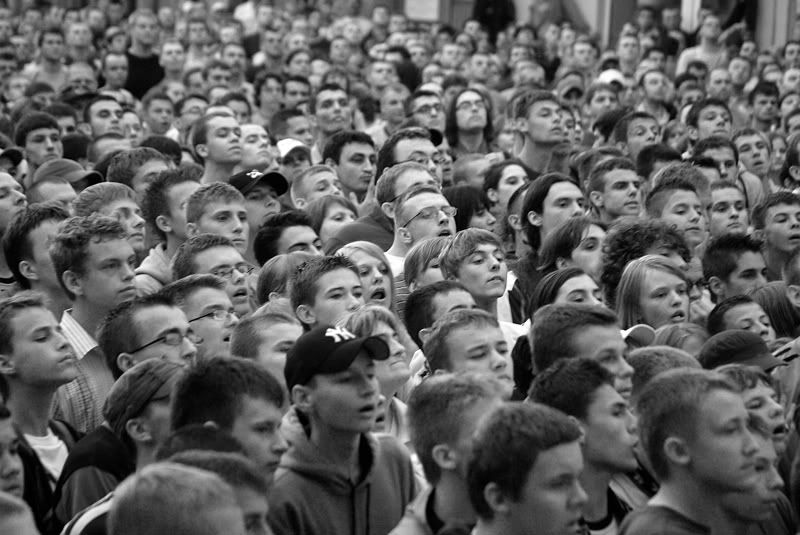
New York is a large metropolis consisting of 8 million inhabitants. Most of the people you meet in a city are faceless individuals whom you recognize only as a fellow human living in the same area. But yet, everyone has a story to tell, regardless of the role they play in their daily lives.
The New York Times has a very interesting photo gallery showcasing the life and story behind the common people. Aptly named “One in Eight Million”, photojournalists photograph and interview New Yorkers who are socially insignificant, and yet these are the people whom make up New York city. Each segment is a short video clip showcasing the daily lives of each individual, accompanied by the narratives of those being interviewed. I love the insights gleaned from the videos – on the subject’s occupation and their take on life. The photography and editing of the video is amazing too!
(Hint: click on the Series Index on the top left of the window to see more interviews)
http://www.nytimes.com/packages/html/nyregion/1-in-8-million/
Photo credit: Griszka Niewiadomski
Thursday, February 11, 2010
Aerial photos of World Trade Centre collapse unveiled
Labels:
gallery,
photojournalism
0
comments

One of the most dramatic events happened on Sept 11, 2001 with the collapse of the World Trade Center twin towers, forever changing international relations and sparking off a series of conflicts and terrorism acts. The intense drama and rivers of human emotions ran deep, and scores of photojournalists documented the aftermath through their lenses. However, one of the most dramatic photo documentation was captured not by a photojournalist, but by a police detective high up in the sky.
NYPD Detective Greg Sermendinger was in a police helicopter hovering above, and in what's probably the world's most haunting aerial photos, he captured the city of New York being engulfed in a plume of dust when the tower collapsed. These images were classified until recently, and they were immensely useful to the investigations of the towers' collapse.
See the series of images at http://abcnews.go.com/Politics/slideshow?id=9763032
Saturday, December 5, 2009
In pictures: 25th anniversary of the Bhopal disaster
Labels:
photojournalism,
Photos
0
comments
During the early hours of December 3 1984, a gas leak at the Union Carbide factory in Bhopal, India killed more than 4,000 people in the first few hours. The poisonous gas swept through the town, and death tolls crept up to more than 15,000 dead within the next few years. 25 years later, the Bhopal disaster is still the world’s worst industrial accident ever, and thousands of people are still suffering from the sickness and deficiency caused by the contamination.
http://www.boston.com/bigpicture/2009/11/25th_anniversary_of_the_bhopal.html
http://www.boston.com/bigpicture/2009/11/25th_anniversary_of_the_bhopal.html
Subscribe to:
Posts (Atom)