Showing posts with label article. Show all posts

Tuesday, December 20, 2011

New Year Resolution

0 comments

Well we've come to the end of the year again, and every new year brings forth new hopes and aspirations. If you feel that you've not done much this year, do not despair... just make sure that you plan well for the following year!

Many times, we may feel bored with photography and start to entertain the idea of buying more equipment to satisfy our insatiable craving for the terrible gear acquisition syndrome (GAS). Instead, why not direct your energy and budget towards books and education? Reading the right books can help advance your techniques and abilities much further than getting another (often unnecessary) piece of equipment.

And of course, the new year brings with it the opportunity to set new goals for yourself. I feel it's a great idea to set a monthly target for the new year, so every month you can look forward to learning or trying out new things in photography. For me, the goal could look like this...

January - Learn Adobe Lightroom
February - Try outdoor fill flash in daylight
March - Shoot portraits of people around me
April - Try time lapse photography
May - Learn how to isolate hair from background in Photoshop
June - Check out color management
July - Do up a photo essay on a favourite topic
August - Explore light painting techniques
September - Shoot with medium format film
October - Shoot studio still life
November - Experiment with photo compositing
December -  Consolidate works for the year into iPad portfolio

The goals could be simple, or perhaps stretch across a few months if its complex, but you set your own pace and interests. Print out a copy and stick it on your wall! And while you may not hit all the targets, it provides a structure and starting place to get you motivated to try something new every month. At the end of the year, you can look back and have a nice little portfolio to chart your improvement through the year.

Get started on your new year photographic resolution today, and feel free to share yours here!

Wednesday, June 15, 2011

Street photography: crop or crap?

1 comments


Lust. Gluttony. Greed. Sloth. Wrath. Envy. Pride.

The last time I checked, cropping is not included in the list of the seven deadly sins. So why do photographers have this compulsive aversion to cropping their photos? Some say that shooting loosely and cropping in post-processing are signs of sloppy technique and a lack of discipline. And that cropping wastes precious real estate of film or digital pixels, degrading the quality of the final image.

I agree fully with the rationale to compose carefully prior to the exposure for certain types of photography, where the photographer has the luxury of time to compose before taking the shot. Landscape or portrait photography, or even commercial or still life photography all fall under such a category. There is little excuse for radically cropping the final image to achieve a new composition, other than to fit the print media size that may be different from the sensor aspect ratio. Or perhaps you really had a square or panoramic image in mind when shooting.

However, it seems to be mostly street photographers or journalists who oppose strongly to cropping their images. I suppose the fact that Henri Cartier Bresson – the most prominent figure in street photography – was a strong advocate of “no cropping” really helped to reinforce such a viewpoint. Photojournalists have resisted cropping for another reason – their editors and layout artists. Photojournalists compose the scene for a reason, and their composition might have included certain elements to tell the story. Editors and layout artists may crop the photo to suit the layout of the page, which frustrates the photographers greatly, and hence haphazard cropping of photojournalistic images may lead to misinterpretation of the original intent of the image, which is why cropping is taboo to some photojournalists.

Many street photographers however, embrace the practice of no cropping without a good argument. In street photography, the world is your stage, and it is an unrehearsed play. Things happen at random and you had hardly lifted the camera up and hit the shutter release, the moment has disappeared. The decisive moment, as Henri Cartier Bresson had aptly termed, is decidedly decisive.

Therein lies the problem of a no cropping policy. In the brief instant where you tried to capture the moment, the expression or action is more important than the composition. Miss the expression or action, and no amount of composition genius can make the photo a masterpiece. Composition can be tweaked in post-processing to improve the photo, so you capture the moment with the ideal composition.

It is a well-known fact that Henri Cartier Bresson, like many photographers, wait for something (or someone) to happen to the scene. In such instances where there is luxury of time to compose, he had the time to compose for the geometry of the composition, which he greatly loved. And I might add (in the risk of sounding sacrilegious), the great photographer himself was not immune to the lure of cropping, as his famous “Man jumping over puddle” image (a true example where the moment matters more than composition) has been proven to be cropped from a wider image (removing lamp posts and other distractions from the left side of the image.

While I am not arguing or lazy or careless framing and composition during exposure, the anally retentive attitude of some street photographers in their insistence not to crop the image seems illogical to me. A great moment happens in front of me, and I’m armed with a 35mm lens instead of a 50mm lens, but nonetheless I captured the image and it is great – except that the composition is too loose. Should I not crop my image? Obviously the wider image was not what I had in mind, but I did not have the luxury of time to change lens or move in closer. Is there something fundamentally wrong with cropping?

Some people say that cropping a photograph changes its meaning. That is true if someone else is cropping your image, but as photographers you infuse the image with meaning. So if you decide to crop your image to express the meaning better, then there should be no reservations about it. As photographers, you have already framed and cropped the world the moment you chose the lens and your viewpoint and composition. Cropping can reinforce your point of view in post-production; it does not change the fact that you had already wanted to impose your viewpoint from the point of exposure.

At the end of the day, I posit that cropping is not inherently detrimental for street photography. If you are cropping to improve the composition because circumstances made it impossible to compose well during exposure, I believe it would make for a better photo. Conversely if the cropping was due to laziness in composing your image when shooting, then it is just a lousy reason and unnecessary step to improve your images. Even so, the immorality can only be attributed to “sloth”, which means cropping is still not any of the seven deadly sins.

Copyright 2011 by Nelson Tan.
All Rights Reserved.
Visit www.nelsontan.com for more articles on photography!

Friday, February 4, 2011

Travel photography - better pictures from every trip!

1 comments


Travel photography is a perennial favourite among many photographers. The promise of seeing the world and its multi-faceted subjects is reason enough for shutterbugs to ditch the comfort of their homes to travel forth and bring back exotic images. So why is it that many of us cringe when asked to sit through a slide show of a friend’s latest travel adventures?

We all had bad experiences of being compelled to view bad travel photography while giving courteous smiles and nods of our heads. Bad photos? Boring images? Probably all that and more! We may not be National Geographic photographers, but certainly we can be all capable of capturing better travel photography with some simple tips!

Equipment

Less is more - it can be tiring to bring too much equipment on your trips. The ability to lug heavy loads vary from photographer to photographer, but in general the advice to bring less gear to reduce fatigue holds true. Avoid bringing gear that you think you might use, and distill down to your essential equipment only. If you are still unsure if you can carry the load, simply pack your bags and head out for a day of shooting to see if you are comfortable with the weight. Whatever seems light at home will probably double in weight in the field!

Plan according to your destination. Research pays off when planning for your gear. If online sources and guide books tell you to expect great landscapes and scenics, you might like to bring along wide-angle lenses and ditch that super long telephoto at home. Or if you know that the destination is a tropical rainforest, pack more waterproof bags and bring along flash equipment to deal with the low lighting levels in the undergrowth. Research helps you bring the right gear and reduce unnecessary weight.

Bring more batteries and cards. It is a terrible feeling to restrict your shooting just because you are low on power or storage capacity. If you have friends using the same batteries, loan the batteries from them before the trip (you can return the favour in future when they go on their travels).  Memory cards are pretty affordable now – get a couple more cards than you might need. There are a lot of things that can go wrong with memory cards, so pack some spares.


Download to a hard disk/notebook if possible. It helps to download your images daily to free up your memory cards, or to act as a backup storage. Although it adds on to the weight, I like to have a notebook computer with me to download and view the images every night, as it is useful to check the images to spot any potential problems with the gear along the trip, rather than discovering the problem when you return after a 14-day trip from a exotic place!

Zoom lenses or primes? My personal preference goes towards zoom lenses for their versatility – I can capture photo opportunities faster and better with a range of focal lengths in a zoom. Prime lenses offer the largest maximum aperture, but I am willing to trade a smaller maximum aperture to capture photo opportunities more fluidly with a zoom lens.

Bring spare equipment if you are really serious about your photography. I usually pack a spare body and lens, kept in the hotel safe deposit, in case my camera or lens conks out on me during the trip. You can also substitute with a compact camera – something is better than nothing.

DSLR, Micro Four-Third or compact camera? Both DSLR and Micro Four-Third cameras can capture great images, although the DSLR still has an edge on image quality by virtue of its larger sensor. With a good range of lenses and fast focusing speed and short shutter lag, I do not have qualms bringing either of them for a trip. Compact cameras in general have small sensors, slower focusing and suffer from shutter lag. While they are suitable for certain situations, I will still avoid using a compact camera as the sole camera for a trip.

What’s in my camera bag

Unless the trip has special requirements (like a safari trip), I usually pack the following focal lengths to deal with general situations. I use full frame DSLRs, so if you are using APS-sensor cameras, you may need to vary your own focal length to adjust for the different sensor size.

- DSLR mounted with mid-range zoom (24-105mm) for general street scenes
- Tele-photo zoom (70-200mm) for distant action
- Spare batteries and memory cards


I like to travel very light, and that is my preferred combination, but your own mileage may vary so choose whatever works for you. I prefer to use f/4 zoom lenses instead of the heavier f/2.8 variants, and I will leave spare equipment in the hotel safe deposit unless I know I need them for the day. So what’s left behind in the hotel?

- Spare DSLR body
- Ultra wide-angle zoom (16-35mm) for landscape/interior
- Fisheye lens
- Flash
- Tripod

I try to keep my bag light and empty, in case I spot something I’d like to buy along the way as a souvenir. And I usually bring my passport along with me in case of emergencies, and for tax rebate purposes for purchases in some countries like Japan.

Packing

NEVER check in your camera/lenses. Luggage handlers are known to be really rough with your bags, and there is a chance your luggage may not arrive with you. Always carry on your gear, especially cameras, lenses and flash. You may check in your non-critical accessories (excluding memory cards and batteries – you need them!) in your luggage if you can’t carry on everything.

Keep your equipment with you at all times. Some countries are more risky when it comes to your personal belongings, so always keep an eye out for your gear. Keep your bag in sight literally, and never leave it hanging off the chair behind you or at your feet. Loop the bag strap around your feet or the chair for added security.


Pack for the country you’re traveling. Be aware of the climatic conditions and prepare your gear accordingly. Sand, dust and water are your gears’ greatest enemies – so be sure to keep your equipment safe from the elements.

Bring power adapters and spare cables. Don’t assume that your hotel or accommodation will have the necessary adaptors or cables. Bring your own adaptors and cables – or even better, bring spares! Your gear is useless without power.

Health concerns, risks and medication. Check out the health risks at the destination before you fly. Check with your family doctor to see if you should be even traveling to the country. You might have to take malaria pills or high-altitude pills for certain places, so prepare your medication at least a month before hand.

Do you need visas and permits? Always check carefully if you need visas and permits to enter the country, and leave enough time for the embassies or authorities to approve the papers. Also be aware of the restrictions of the visa or permits, such as the scope of travel or the duration of the tour.

Lighting


Beautiful lighting is unusual lighting. The most photogenic lighting takes place in the early or late hours of the day, or in the most unlikely places. It is a classic scenario where less is more – beautiful lighting occurs less frequently and in lesser amount.  So wake up early to catch the first light, and stay around longer when others have packed (assuming it’s safe to do so!).

Never stop observing or shooting – take note of the lighting conditions and see the results on your images. Analyze what makes the lighting work, and the conditions for it to happen. It may be a burst of sunlight streaming through the leaves, or a ray of sunlight reflecting off a window. A famous photographer once said that there is no right subject, it’s just finding the perfect lighting.

Editing

Editing your sequence is an important skill, but it has been delegated way below Photoshop editing skills unfortunately! Travel photography involves telling a story about the place using a series of photos, and being able to edit your sequence can make or break your travel photos.

Be critical of what you show others. Editing involves the selection of the right images, the right quantity and the right order. Toss out the technically bad and meaningless photos, followed by the mediocre images and so on. Learn to edit your images ruthlessly, and do not let your emotions during the moment of photo taking affect your judgement. Even if you have spent much effort capturing the shot, if it does not look good or fit into the story, out it goes. Find a good photographer friend to help you toss out images if you are unable to remain neutral.


Arrange the images in a sequence that tells a story. You can arrange by chronological order or by your trip itinerary, but it should be flow well as a story. Imagine yourself giving a narrative for the slideshow – does it flow well or does it sound like a jumbled up story?

Keep your story short but compelling. It is better to leave the audience hankering for more, rather than wishing the slideshow to end sooner. Audiences have short attention spans, so any slideshow sequence longer than five minutes is really stretching it! I personally like to keep it under five minutes, with less than fifty images in total lasting five seconds or less each on the screen.

Use music to accompany your slideshow to liven up the presentation – it can be remarkably awkward viewing images in silence, especially if you have nothing interesting to narrate about your images along the way. Choose a piece that fits the mood and theme of your slideshow. I like using iPhoto on a Mac to do up my slideshows, and you can find your own favourite software to do the same.

The sense of place

What makes this place unique from the rest? That should be the question that your images aim to answer. Good travel photography provides the viewer with a sense of place, telling them the unique characteristics about the place and its people. But how do you capture the sense of place?

Include wide-angles, mid-shots and close-ups. A National Geographic photographer once gave this useful tip in taking photos that capture the sense of place. Too often photographers are comfortable with shooting in one style that all images during the trip look the same. You end up with too many wide-angle shots or people shots, so the slideshow fail to tell the complete story of the place. Learn to vary your images with wide-angle scenic shots, mid-shots of people and close-ups of their artifacts.


Capture the PLACE - People, Landscape, Activities, Culture and Environment. A slideshow that reflects only a couple of aspects of the place can be extremely tedious to watch. Make sure that you photograph the various components of PLACE to deliver a well-rounded presentation of your travel destination.

Don’t be shy in approaching people - you have greater “allowance” as a tourist. Most of the locals will be more open and tolerant of your photography because you are a tourist, so be nice to them and there is a high likelihood that you will be permitted to photograph them. But be sure to respect the culture! Some cultures do not take well to certain photography, so read up ahead before shooting.

If you are interested in learning more about the sense of place, I highly recommend reading “The spirit of place” by Bob Krist. It’s a wonderful book by the renowned travel photographer on capturing the gist of your travel destination in your photos.

Conclusion


Travel photography is fun, and you need not travel to exotic destinations to achieve great results. Keep your eyes open for various opportunity to photograph subjects, open your mouth to ask trusted locals (or even the hotel concierge) where to find the most photogenic subjects or spots, and keep your mind open to the following three criteria for the best travel photos:

- Convey the sense of place in your photos
- Offer a personalized point of view, not a postcard reproduction
- Ensure your images tell a coherent story as a set

Good luck and enjoy your trip!

For more articles and tips, visit www.nelsontan.com today!

Text and images are copyright property of Nelson Tan, and may not be reproduced in any form or format without prior written permission of the author. 
(C) Copyright 2011 Nelson Tan
All rights reserved.

Wednesday, August 18, 2010

Joys of medium format cameras

0 comments


We all love the tale of David vs Goliath, where the underdog trumps the favourite against all odds. The truth in life is - size does matter. The bigger is usually the better option. Try driving a Mini on the road with Landrovers and Hummers all around you, or get into a gun fight armed with a pistol against a sub-machine gun - you get the picture.


In photography, the smaller cameras are more agile, as in all our examples. But in terms of sheer power, nothing quite beats a larger format camera, ceteris paribus. The larger the film area (or sensor size), the cleaner the image and the better the enlargements will be. Traditionally, a lot of commercial images used for billboards or posters are shot on medium or large format cameras, and even with today's pow-wow 35mm DSLRs excellent image quality, some of the professionals still opt for medium format cameras to deliver that extra edge, especially in controlled environment shooting where speed is not of essence.


Apart from sheer quality, one of the fun aspects of shooting medium format cameras is the joy of handling something mechanical. Unlike the DSLRs, the majority of medium format cameras still shoot on film (since digital backs are still prohibitively expensive for the hobbyists). That only adds to the joy of loading film (assuming you come from the film-era like me), which is a more tactile approach than loading a CF card into my DSLR. Furthermore, a lot of the medium format cameras are mechanical machines that click and clunk, quite unlike the zip and whirl of the electronic cameras today.


Need more convincing to try medium format cameras? Well... how about the fact that a lot of medium format gears are very affordable now compared to a decade ago, and you can get a good camera and lens for less than 500 bucks? And once you have a taste of the heavenly experience of viewing a medium format slide on a light-box, you'd want to run out to get a few more rolls of film!

So be sure to discover more about medium format cameras here at http://www.nelsontan.com/articlespage/mediumformat01.html

Have fun!

Monday, August 9, 2010

Is photography weighing you down?

0 comments
Unlike sports like tennis and even cycling, where equipment have gotten lighter through the years with technological advances, photography seems to have gone the other way round. Compare the camera and lenses of yesteryear, today's gear seems absolutely humongous and outright unwieldy! If you are a car enthusiast, you'd know that an average car today weighs around 1.3 tonnes, compared to under 1 tonne just twenty years ago.

And since manufacturers seems adamant in packing in more weight, it's a good time to watch your back - literally. For serious photography enthusiasts, it's not uncommon to be lugging around bags weighing more than 5kg (11 lbs), which is akin to carrying a big bag of rice around! So what can you do to avoid contributing your hard-earned cash to the chiropractor?

Check out this latest article I wrote - "Is photography weighing you down?" about managing your equipment and gear out in the field. It's important not to mess with your spine - back-related injuries can last a lifetime!

Wednesday, January 6, 2010

The Empire Strikes Back!

0 comments
Empire magazine has commissioned the shoot of various Hollywood A-listers to be photographed in their studio against a plain background, representing their most iconic character in a movie. I can’t in good conscience say that they’re the best photos, but its sure fun to see some of the stars playing the characters out of a set!

What is your favourite?

http://www.empireonline.com/gallery/gallery.asp?GID=2353

Saturday, January 2, 2010

Canon and Nikon = Romeo and Juliet?

0 comments
Oh boy... this is good... someone just made a video about the "Romeo and Juliet" story of a pair star-crossed lovers. Both are photographers, but he is a Canon guy and she's a Nikon gal! Don't take it seriously, but its quite a laugh hearing the "hatred" and "differences" of both camps. Every brand fanatic should watch this and have a good laugh at themselves!


Space – the final frontier for Nikon

0 comments
Normally it wouldn’t be a big deal if a huge camera company like Nikon receives an order for 11 cameras and 7 lenses. In fact, Nikon probably won’t even want to entertain such a miniscule order! Unless of course the customer happens to be American space agency NASA, and the “small order” justifies a press release. Nikon announced recently that NASA has placed an order for 11 sets of Nikon D3S and 7 units of the AF-S Nikkor 14-24mm f/2.8G ED lens for their space mission. According to the press release, NASA has been using Nikon to capture more than 700,000 pictures in space. To infinity and beyond!


Damn it, Jake! I told you to hold on to it!

Thursday, December 31, 2009

How tough is your lens?

0 comments
Boredom is dangerous, because a bored photographer decided to try smashing his (already non-functioning) Canon lens to see how fragile the lens is. Amazingly, the lens is one tough cookie! Kids, do not try this at home…


Saturday, November 28, 2009

Retro chic with old rangefinder cameras

0 comments
People are funny… we try so hard to out-do ourselves and make things better. And with technological progress and the digital edge, everything seems so nice and perfect. And we start to bemoan “the loss of spirit” with digital audio CDs and digital cameras. Suddenly everything analogue becomes in vogue and cool again… vinyl records and film are “in” once more!

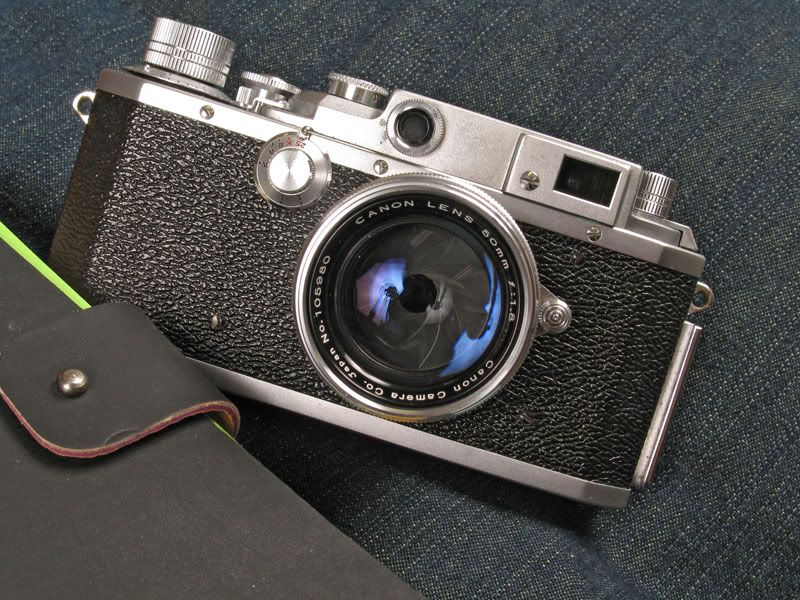
Of course, if you wanna be with the in-crowd, make sure you’re fashionable all the way. Having some old film camera from your dad’s drawer isn’t gonna cut it (seriously it only makes you look old-fashioned!). For true retro coolness, you gotta reach into your grandpa’s drawer for his ancient Leica rangefinder. But most probably you’d find something like this…