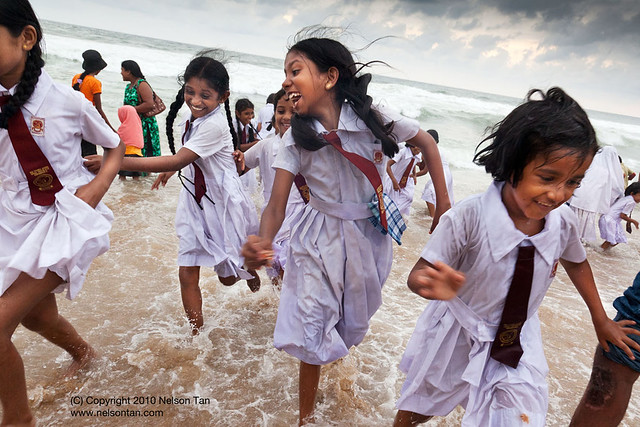
Lust. Gluttony. Greed. Sloth. Wrath. Envy. Pride.
The last time I checked, cropping is not included in the list of the seven deadly sins. So why do photographers have this compulsive aversion to cropping their photos? Some say that shooting loosely and cropping in post-processing are signs of sloppy technique and a lack of discipline. And that cropping wastes precious real estate of film or digital pixels, degrading the quality of the final image.
I agree fully with the rationale to compose carefully prior to the exposure for certain types of photography, where the photographer has the luxury of time to compose before taking the shot. Landscape or portrait photography, or even commercial or still life photography all fall under such a category. There is little excuse for radically cropping the final image to achieve a new composition, other than to fit the print media size that may be different from the sensor aspect ratio. Or perhaps you really had a square or panoramic image in mind when shooting.
However, it seems to be mostly street photographers or journalists who oppose strongly to cropping their images. I suppose the fact that Henri Cartier Bresson – the most prominent figure in street photography – was a strong advocate of “no cropping” really helped to reinforce such a viewpoint. Photojournalists have resisted cropping for another reason – their editors and layout artists. Photojournalists compose the scene for a reason, and their composition might have included certain elements to tell the story. Editors and layout artists may crop the photo to suit the layout of the page, which frustrates the photographers greatly, and hence haphazard cropping of photojournalistic images may lead to misinterpretation of the original intent of the image, which is why cropping is taboo to some photojournalists.
Many street photographers however, embrace the practice of no cropping without a good argument. In street photography, the world is your stage, and it is an unrehearsed play. Things happen at random and you had hardly lifted the camera up and hit the shutter release, the moment has disappeared. The decisive moment, as Henri Cartier Bresson had aptly termed, is decidedly decisive.
Therein lies the problem of a no cropping policy. In the brief instant where you tried to capture the moment, the expression or action is more important than the composition. Miss the expression or action, and no amount of composition genius can make the photo a masterpiece. Composition can be tweaked in post-processing to improve the photo, so you capture the moment with the ideal composition.
It is a well-known fact that Henri Cartier Bresson, like many photographers, wait for something (or someone) to happen to the scene. In such instances where there is luxury of time to compose, he had the time to compose for the geometry of the composition, which he greatly loved. And I might add (in the risk of sounding sacrilegious), the great photographer himself was not immune to the lure of cropping, as his famous “Man jumping over puddle” image (a true example where the moment matters more than composition) has been proven to be cropped from a wider image (removing lamp posts and other distractions from the left side of the image.
While I am not arguing or lazy or careless framing and composition during exposure, the anally retentive attitude of some street photographers in their insistence not to crop the image seems illogical to me. A great moment happens in front of me, and I’m armed with a 35mm lens instead of a 50mm lens, but nonetheless I captured the image and it is great – except that the composition is too loose. Should I not crop my image? Obviously the wider image was not what I had in mind, but I did not have the luxury of time to change lens or move in closer. Is there something fundamentally wrong with cropping?
Some people say that cropping a photograph changes its meaning. That is true if someone else is cropping your image, but as photographers you infuse the image with meaning. So if you decide to crop your image to express the meaning better, then there should be no reservations about it. As photographers, you have already framed and cropped the world the moment you chose the lens and your viewpoint and composition. Cropping can reinforce your point of view in post-production; it does not change the fact that you had already wanted to impose your viewpoint from the point of exposure.
At the end of the day, I posit that cropping is not inherently detrimental for street photography. If you are cropping to improve the composition because circumstances made it impossible to compose well during exposure, I believe it would make for a better photo. Conversely if the cropping was due to laziness in composing your image when shooting, then it is just a lousy reason and unnecessary step to improve your images. Even so, the immorality can only be attributed to “sloth”, which means cropping is still not any of the seven deadly sins.
Copyright 2011 by Nelson Tan.
All Rights Reserved.
Visit
www.nelsontan.com for more articles on photography!